Summary
READ ITLive shopping has moved from a niche experiment to a real channel for e-commerce brands. A single live event can drive real-time engagement, build trust with an audience, and increase sales in ways a static product page never will. But most brands still make the same mistake: the stream ends, the recording sits untouched on a channel, and all that value quietly disappears.
In 2026, the smartest brands treat that recording as the actual asset. The live session is just the raw material. What you do with it afterward is where the growth compounds.
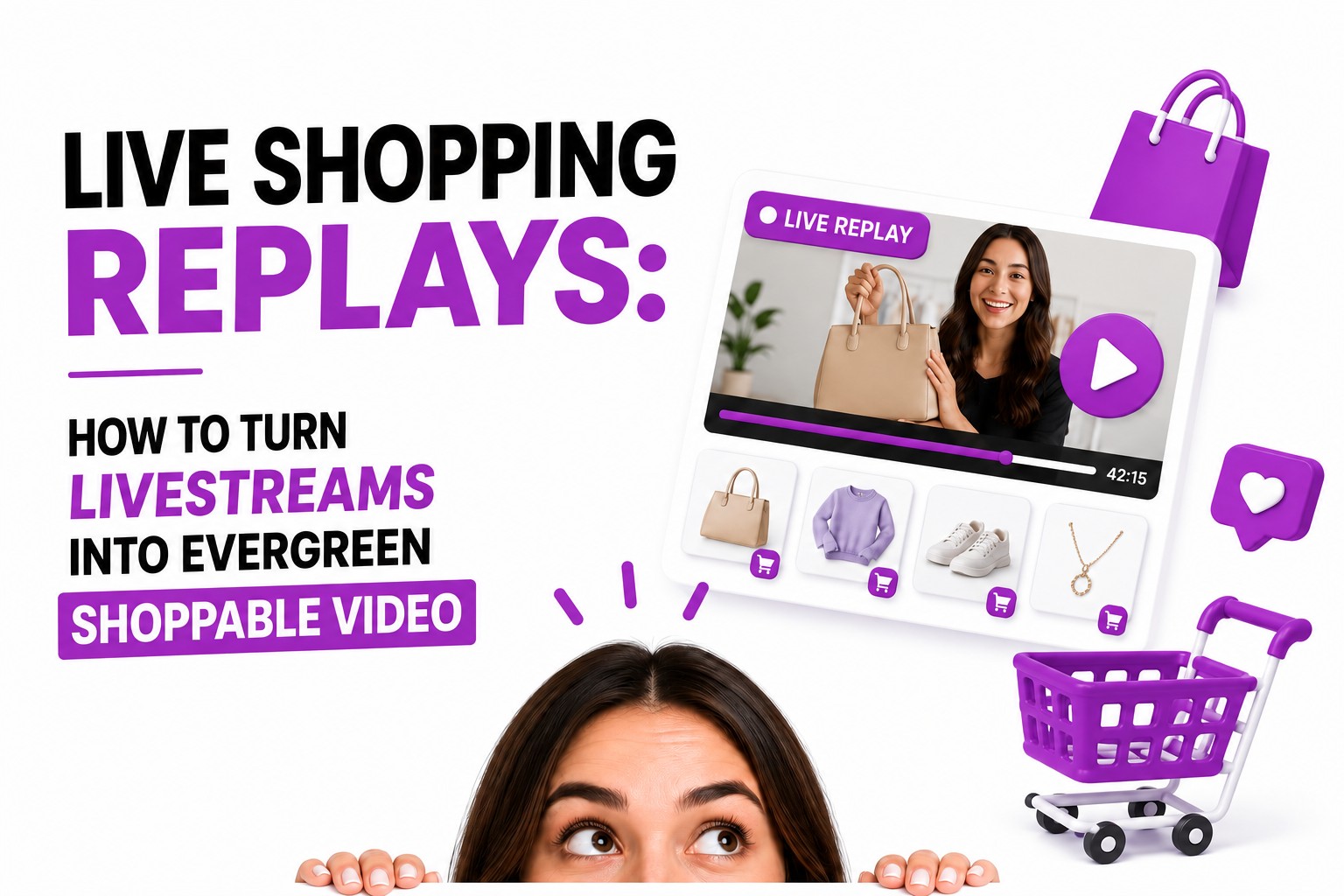
This playbook walks through how to turn live shopping content into evergreen shoppable video that keeps working for your site long after the audience has logged off.
Why live shopping content deserves a second life
A live shopping session is expensive to produce well. You need a host, a plan, product staging, and often a platform fee. Treating that investment as a one-time session is a missed opportunity.
A saved recording offers three advantages over the live stream itself:
- It's available on demand, so new visitors can watch and buy at their own pace.
- It can be broken into shoppable segments that live permanently on product display pages (PDP).
- It keeps generating traffic and conversion without needing a live host again.
Brands running live commerce on Amazon Live, TikTok, or Instagram already have hours of usable footage sitting in storage. The opportunity is turning that raw stream into structured, shoppable content people can actually find and buy from later.
.png)
The shift from live event to evergreen shoppable video
Live commerce is growing fast because it mixes entertainment with commerce in a way a PDP cannot. A host can turn a product around, answer a question, or share a comparison in real time. That real-time engagement builds trust and drives the purchase decision.
But once the session ends, that same footage still holds all the same selling power. A beauty demo that converted during a live session will still convert a month later, as long as the viewer can find the exact moment that matters to them.
This is where the 2026 approach differs from how brands handled this content a few years ago. Instead of publishing one long recording and hoping people scroll through it, brands now segment the video into short, purpose-built pieces tied to specific items.
Step 1: Capture the stream with reuse in mind
Before you even go live, plan for what happens after. This changes how you structure the session itself.
- Introduce each product clearly by name, so it's easy to identify later.
- Leave natural pauses between items, since these become good breakpoints.
- Keep a run of show so you know which moment maps to which product.
- Record in a vertical or square format where possible, since that's what performs best on social media platforms and PDPs .
A little structure during the live stream saves hours of editing afterward.
Step 2: Auto-chapter the stream by product
The biggest technology shift in live commerce this year is automatic chaptering. Instead of one long stream, the recording gets segmented into sections that correspond to each product shown live. A viewer can jump straight to the point that matters to them instead of watching from the start.
This helps for two reasons. First, it respects the viewer's time, which increases the chance they actually watch and convert. Second, it turns one live session into many pieces of standalone content, each tied to a specific PDP.
In practice, this means:
- Tagging the moment where each product is introduced.
- Naming each section after the item, not a generic label like "Part 3."
- Exporting each section as its own piece of video, not just a link inside a long stream.
This is the difference between content that sits unused and a library of shoppable video that keeps driving traffic.
Step 3: Make every video shoppable
A well-tagged section is only half the job. It needs to let the viewer buy without leaving the experience.
For each product segment, include:
- A clear product tag linking straight to the PDP.
- A short caption repeating the key offer or exclusive discount mentioned live.
- A visible call to action, so the viewer knows they can buy right there.
This is where the right tool matters. Instead of a static video sitting on the page, it becomes an interactive shopping experience where the viewer can click, browse, and add to cart without a page reload.
If you're already building this kind of media library, it's worth pairing the effort with a broader plan for repurposing your brand's UGC into featured campaigns, since live media and influencer media usually work best when they're managed under one system.
Step 4: Place shoppable content where customers are shopping
Once you have shoppable video, distribution decides whether it actually gets found.
- PDPs. Place the relevant segment directly on the page it matches. A customer researching that merchandise gets the exact demo that helped convert live viewers.
- Homepage or collection pages. Feature a highlight reel of your best live moments as a brand to build trust with new visitors and grow reach.
- Social media. Share individual item segments natively, tagging the original session so followers know there's more to find.
- Email and SMS. Send a segment about a specific item to a base of subscribers who showed interest but didn't buy live.
The goal is to connect with the shopper on whatever platform they're already using, rather than asking them to go find a recording buried on a platform.
.png)
Step 5: Treat video as an ongoing content asset
Once this media is chaptered and shoppable, it should be measured the same way you'd measure any other page asset.
- Track watch time, click-through, and conversion per segment, not just for the full stream.
- Test which item framing or discount performs best, and reuse that approach in future live session.
- Retire or refresh sections tied to discontinued products or expired offers.
- Localize top-performing video with subtitles or dubbing to reach a global audience.
This turns your live shopping program into a growth channel instead of a one-off session on the calendar.
Common mistakes brands make with live content
Even brands that understand the value of live commerce often stumble on execution. A few patterns show up again and again.
The first mistake is publishing the full, unedited stream and calling it done. A customer who wasn't part of the original live event has little reason to sit through an hour of video to discover the one product they care about. Without sections or shoppable tags, the recording becomes passive rather than a real sales tool, and most of that traffic leaves before it reaches a purchase.
The second mistake is treating every platform the same way. A segment built for TikTok won't necessarily work the same way once it's placed on a product page or shared over email. The format, pacing, and even the offer mentioned on screen may require small adjustments per channel. A good example to study is how brands approach TikTok Shop with affiliates, live, and GMV Max, since that platform has its own rules around what performs well natively versus what requires reworking for reuse elsewhere.
The third mistake is losing the offer. Live sessions often include exclusive discounts or limited-time bundles to create urgency in the moment. If that offer isn't clearly carried into the saved content, much of the original intent to buy disappears with it. Either update the segment with a current offer or make clear the promotion has ended, so the customer isn't confused at checkout.
Finally, many brands never assign ownership of this workflow. Scheduling a live event is easy. Chaptering it, tagging products, and sharing content across channels needs a clear process and someone responsible for it. Without that support, this content defaults back to sitting unused, which is exactly the problem this playbook is meant to solve.
Why customer engagement matters more in 2026
Live commerce has matured well past the early experiments. Conversion during live sessions on platforms like TikTok and Instagram already runs several times higher than a standard product page, and brands are increasingly expected to make the most of every session, not just the hour it airs.
At the same time, consumers are discovering products through more channels than ever, from search to social to AI-powered assistants. Well-tagged, shoppable video gives you another surface to be discovered on, one that keeps working without requiring a host, a platform fee, or a live audience in the moment.
Brands that treat live shopping as a single event are leaving most of the opportunity on the table. The stream is the beginning. The shoppable video library is the long-term growth strategy.
Getting started with your live shopping strategy
You don't need a large production team to start turning live content into evergreen shoppable video. Start small:
- Pick your best-performing live session from the past few months.
- Chapter it by product using the timestamps you already have.
- Turn the top two or three moments into shoppable video.
- Place them on the matching product pages and see what happens to traffic and conversion.
From there, build the habit into every future live session: plan for reuse before you go live, chapter the stream right after, and give each piece of content a permanent home where customers are already shopping.
Live shopping earns attention in the moment. A good evergreen strategy is what keeps that attention working for your business long after the stream ends.
.jpeg)