
Résumé
LISEZ-LEUser-generated content has always been one of the highest-converting formats in paid social. Unscripted, direct-to-camera testimonials outperform polished brand spots in most Meta placements not because output quality is low, but because they feel authentic. The problem is that sourcing, briefing, and waiting on human talent does not scale. A push that needs twenty hook variations across five ad sets cannot wait two weeks for deliverables.
That is where synthetic UGC video tools come in. These platforms use realistic AI actors and talking-head generation to produce creator-style clips from a brief, a product image, or a URL in minutes rather than days. For firms managing high-volume Meta accounts, they change the economics of creative output entirely.

What is AI UGC content generation?
AI UGC makers are software tools that use generative AI to produce paid social spots designed to look like organic, creator-made material without a real person, camera, or crew. They typically combine realistic synthetic actors, automated voiceover, and intelligent editing to produce talking-head or testimonial-style clips from a brief, product URL, or image. The output is formatted for placements on Meta, TikTok, and YouTube, and is built to perform like authentic user-generated material in the feed.
Why agencies are adopting AI UGC tools to scale video production now
The bottleneck in Meta advertising is no longer targeting or budget. Audiences burn through assets faster than most teams can replace them. According to HeyGen's 2026 review of AI tools for marketing, synthetic UGC now costs roughly $2 to $20 per clip compared to $50 to $500-plus for human talent. That cost difference at volume is significant, particularly when firms are testing dozens of variants per client each billing cycle.
The quality gap has also narrowed considerably. Short-form talking-head spots produced by current generative tools are, in most cases, nearly indistinguishable from real talent footage in feed environments where viewers scroll past in under three seconds. The bottleneck is no longer quality it is how fast your team can write briefs, iterate hooks, and push new material into the learning phase.
Arcads: best for high-volume talking-head UGC ads
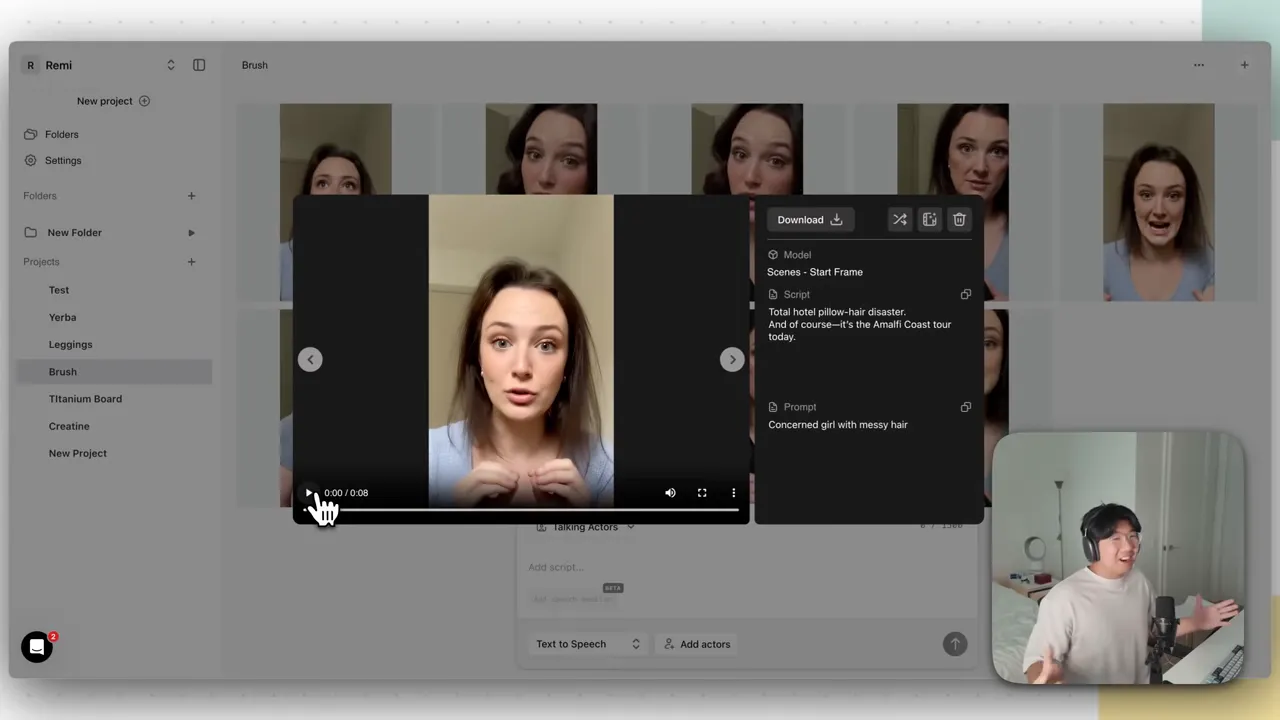
Arcads is the most purpose-made tool on this list for direct-response Meta work. Its entire workflow is designed around producing talking-head UGC clips from a text brief using a library of 300-plus realistic synthetic actors.
Arcads features and workflow
You paste your copy, pick an actor, and get a finished clip in approximately two minutes. What separates Arcads from general avatar tools is its focus on feed-native output. The actors are motion-captured rather than synthetically rendered, which means facial expressions and delivery feel closer to how a real person actually speaks on camera. For hook testing where you need the same brief delivered with three different openings across multiple presenters the batch output feature handles that in one session.
Arcads pricing and best fit for agencies
Arcads starts at around $110 per billing cycle, which puts it at a higher floor than most competitors. The per-clip economics work out at roughly $11 per output on standard tiers, which justifies the cost for firms producing 50-plus pieces a month. Below that volume, the cost per asset is harder to defend.
The tool does not have a URL-to-clip workflow, so product context needs to come from the brief itself. It also lacks native Meta integration, meaning exports go into your account manually. Best suited for: performance firms with high output volume and a strong copywriting process already in place.
Creatify: best AI UGC video generator for product-based campaigns
Creatify takes a different approach. Its core workflow starts from a product URL rather than a written brief. Paste a Shopify, Amazon, or brand page link, and the tool pulls item information, writes copy, selects synthetic actors, and produces a complete UGC-style clip with subtitles and voiceover.
Creatify's URL-to-ad creation process
For ecommerce clients with large catalogues, that URL-to-clip pipeline removes most of the setup work. A team managing thirty SKUs can produce a base spot for each in an afternoon rather than a week. The actor library runs to 1,500-plus on paid tiers, with support for 29 languages on the Starter subscription. Batch output lets you build multiple variations simultaneously, useful for testing different hooks or styles against the same offering without rebuilding from scratch each time.
Creatify pricing and agency use case
Creatify fees start at $19 per billing cycle on the Starter tier, with a free option offering ten credits. The Pro package at $49 per cycle unlocks the full actor library, custom presenter creation, stronger rendering models including Sora 2 Pro and Veo 3.1, and direct publishing to Meta and TikTok.
The trade-off is creative control. Because output is largely automated from the URL, results are consistent but less flexible than a tool where you write the brief from scratch. Best suited for: ecommerce-focused studios that need high-volume material fast and want to minimise manual input.
HeyGen: best for multilingual avatar video ads at scale
HeyGen is the strongest option on this list for multilingual paid social work. Its core advantage over Arcads and Creatify is language coverage 175-plus languages with machine-powered voice cloning and lip-sync that adjusts to the target language rather than just dubbing over the original track.
HeyGen's AI avatar and multilingual support
For firms managing international clients or executing across multiple regions from a single brief, HeyGen removes the need to refilm or re-brief for each market. Write the copy once, clone the presenter's voice into French, German, Portuguese, and Japanese, and export format-ready assets for each. The platform also supports custom digital figure cloning meaning a brand's actual spokesperson can be digitised and used to deliver new copy without scheduling further shoots.
HeyGen pricing and campaign fit
Rates start at $29 per billing cycle with a free tier offering three clips a month, scaling to $149 per cycle on the Business package.
Where HeyGen is weaker is in feed-native hook formats. The output looks polished, which works well for spokesperson-style spots and demos, but can read slightly too clean for the scrappier UGC aesthetic that performs in Meta's feed. Best suited for: firms with multilingual clients or those producing presenter-led material rather than raw-looking talent spots.
Captions: best AI video editor for agencies with existing content
Captions sits in a different category from the tools above. Rather than producing talking-head footage from scratch, it is built around editing and enhancing existing clips either self-recorded or imported with intelligent subtitling, auto-cut, B-roll insertion, and a text-based editing interface.
How Captions handles AI editing and script-based workflows
The platform's Cappy feature, launched in April 2026, lets users edit footage by typing instructions in plain words rather than using a timeline editor. That makes the process accessible for team members without backgrounds in post-production, which matters for studios where junior strategists manage iteration alongside senior media buyers. For UGC work, Captions performs best when a client has existing footage item shots, founder clips, customer testimonials that needs turning into a polished spot without a full output pass.
Pricing
The Business package runs at $399 per billing cycle, which is the tier where ad-grade output and export quality are available. Best suited for: firms with access to real footage that need fast, intelligent editing rather than fully synthetic output.
Synthesia: best AI avatar tool for B2B and brand campaigns
Synthesia is the enterprise standard for synthetic presenter footage and has been for several years. With 160-plus digital figures and allows for 140-plus languages, it handles scale and coverage better than almost any other tool on the market. Reuters, Amazon, and Accenture use it for internal communications and training material.
.png)
Synthesia's avatar library and enterprise features
For Meta work, Synthesia is generally the wrong choice. The output is highly polished and presenter-led, which works for explainer material and corporate efforts but does not match the informal, direct-to-camera style that performs in social feeds. Rates start at $22 per billing cycle on the Starter tier.
When Synthesia fits your agency client mix
The exception is firms executing B2B pushes where a professional, structured spokesperson format is appropriate. LinkedIn, YouTube pre-roll, and awareness-stage Meta efforts for enterprise clients are environments where Synthesia's output fits the brief. Best suited for: groups with B2B clients or those producing internal and educational material alongside paid social.
AdStellar: best for agencies that require to generate and launch Meta campaigns in one platform
AdStellar is the only tool on this list that combines UGC clip output with full Meta launch and real-time performance tracking in a single environment. You build synthetic actor spots, image assets, and visual variants, then push them directly into Meta without leaving the platform.
AdStellar's UGC generation and real-time performance tools
The performance layer is what makes it distinct. AdStellar tracks ROAS, CPA, and CTR across every asset variant in real time, surfaces winners on a leaderboard, and feeds that data back into the next build cycle. For firms executing continuous testing programmes, that closed loop between output and performance reduces the manual work of identifying what to scale. A competitor spot cloning feature pulls winning material from the Meta Ad Library and builds similar UGC variations a practical research shortcut for studios benchmarking against category leaders.
AdStellar pricing and creative testing workflow
Fees run from $49 per cycle on the Hobby tier to $499 on Ultra, with a seven-day free trial across all packages. Best suited for: firms that want to collapse the gap between clip output and account management into one tool.
How to choose the right AI UGC tool for your agency workflow
The decision comes down to where your current workflow breaks. If copywriting is already strong and you need volume fast, Arcads is the most direct path. If clients have large catalogues and you want to cut setup time, Creatify's URL-to-clip flow is the right starting point. If international efforts or multilingual localisation is a regular requirement, HeyGen handles that better than anything else on the list. If your team works with real footage and needs fast, intelligent editing rather than full synthesis, Captions fills that gap. For B2B-focused studios or those producing structured explainer material, Synthesia is worth the investment. And if your group wants output and account management in one environment, AdStellar is the only tool that offers both.
Most firms executing serious Meta programmes end up using two tools: one for high-volume output and one for editing or account integration. The economics support it. At $2 to $20 per synthetically produced clip versus $100 to $500-plus for human talent, even a combination of two paid tiers costs a fraction of a single monthly retainer and produces ten times the output.
.jpg)
.jpg)